North America Luxury Market Report March 2025
Presented by Mountain Rose Realty and Anne-Britt Ostlund
Want your own copy of the report? The full 24-page report covers Telluride as well as other resort markets in the US and Canada. Download the full Telluride monthly luxury real estate market report here. Get yours today!
North America Luxury Market Report - March 2025
As we move through 2025, the luxury real estate market in North America continues to evolve, shaped by economic trends, shifting buyer preferences, and fluctuating inventory levels. This month’s report highlights key data and insights that impact buyers and sellers in Telluride real estate and beyond.
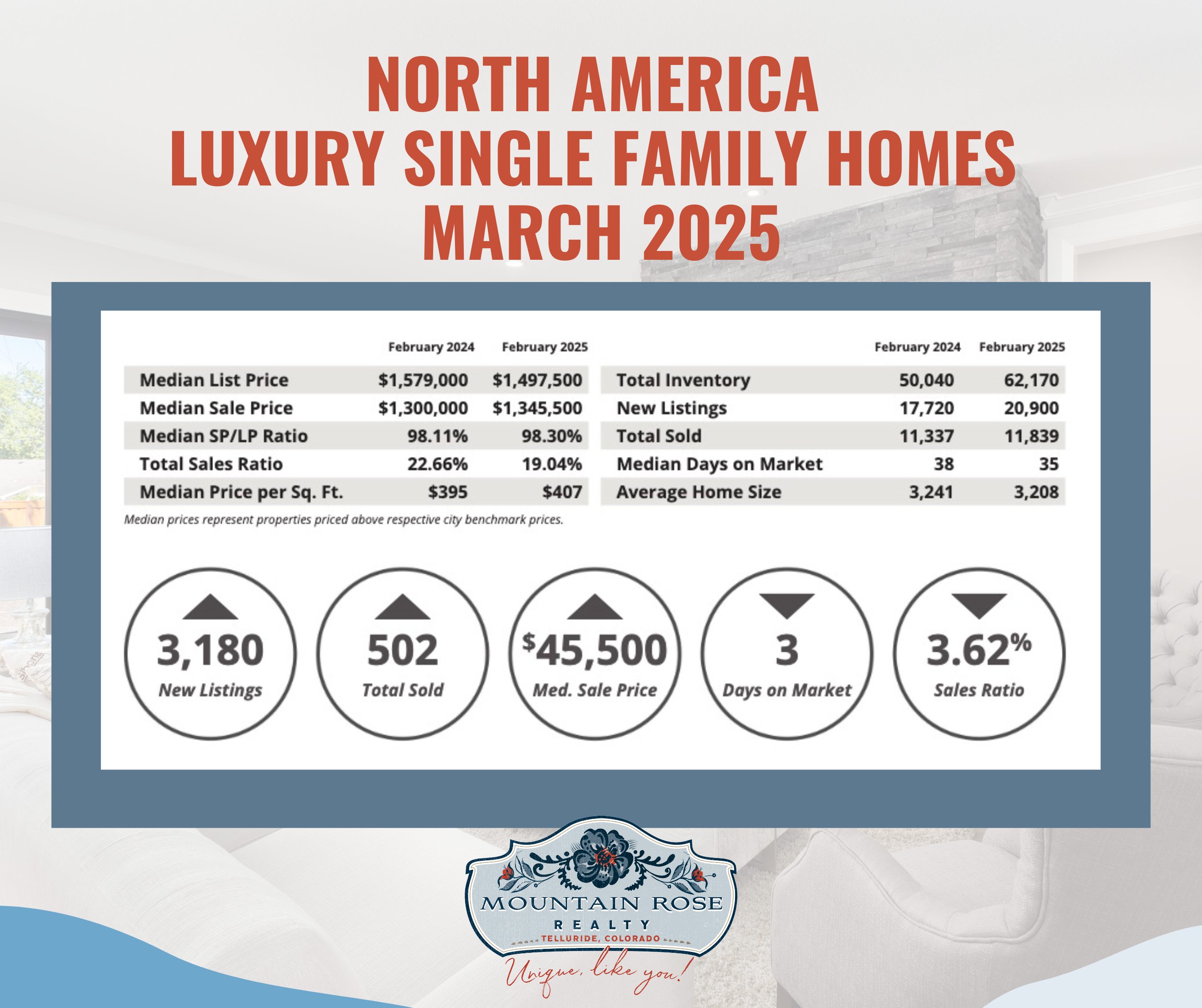
Single-Family Homes Market Summary | February 2025
-
Market Type: Balanced Market with a 19.04% sales ratio
-
Homes selling for an average of 98.30% of list price
-
Median luxury threshold price: $900,000
-
Median luxury home sales price: $1,345,500
-
Highest Median Sales Prices:
-
Pitkin County: $17,471,974
-
Telluride: $5,492,500
-
Eagle County: $4,850,000
-
South Walton: $4,825,000
-
-
Markets with the Highest Sales Ratio:
-
East Bay: 70.9%
-
Seattle: 57.2%
-
King County: 49.2%
-
Baltimore City: 46.2%
-
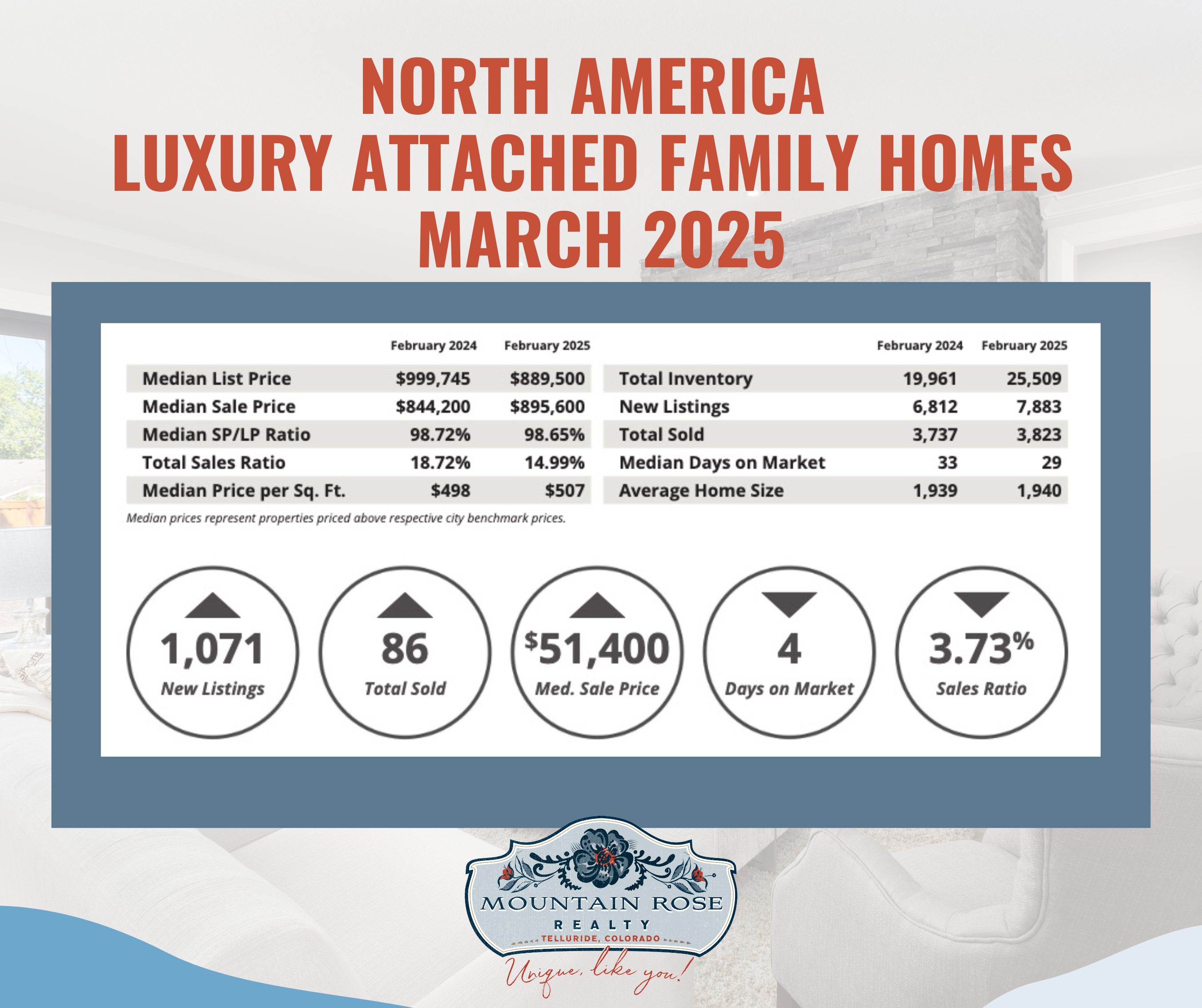
Attached Homes Market Summary | February 2025
-
Market Type: Balanced Market with a 14.99% sales ratio
-
Attached homes selling for 98.65% of list price
-
Median luxury threshold price: $700,000
-
Median attached luxury sale price: $895,600
-
Highest Median Sales Prices:
-
Sonoma County: $3,500,000
-
Park City: $3,370,000
-
Whistler: $3,160,000
-
Pitkin County: $3,150,000
-
-
Markets with the Highest Sales Ratio:
-
Howard County, MD: 90.3%
-
Fairfax County, VA: 89.4%
-
Arlington & Alexandria, VA: 71.2%
-
Silicon Valley: 60.3%
-
Luxury Market Trends & Insights
The North American luxury real estate market has seen steady momentum, bolstered by strong buyer demand and decreasing interest rates. However, economic uncertainties continue to influence investor decisions, leading to cautious optimism among sellers and buyers alike.
Key Similarities Between U.S. & Canadian Luxury Markets
-
Interest Rates & Buyer Caution: Declining rates have spurred renewed market activity, but concerns over the economy have tempered enthusiasm.
-
Ultra-Luxury Market Resilience: High-net-worth buyers remain active, prioritizing desirable properties over financing conditions.
-
Growing Inventory: Baby Boomers are selling off luxury properties, while Millennials and Gen Z are entering the high-end market with a preference for sustainability and smart home features.
-
Single-Family Homes in High Demand: Luxury buyers across North America continue to favor single-family residences over condos.
-
Strategic Pricing Matters: Buyers are selective, making it crucial for sellers to price strategically and highlight unique property features.
Key Differences Between U.S. & Canadian Luxury Markets
-
Tax & Investment Policies: Canada enforces stricter foreign buyer regulations and taxation policies, while the U.S. offers more flexibility for international investors.
-
Market Competition: Canada’s luxury market remains tight in cities like Toronto and Vancouver, while the U.S. has a more diverse landscape from New York penthouses to Texas ranch estates.
-
Demographics: Canada sees more family-driven luxury purchases, whereas U.S. buyers include both lifestyle and investment-driven clientele.
-
Regulatory Differences: Canada’s foreign buyer restrictions shape investment patterns, while the U.S. remains a prime destination for international luxury investors.
Global Luxury Real Estate Outlook
International trends continue to shape the North American luxury market. Key insights from The Wealth Report by Knight Frank reveal:
-
Global real estate investments have declined by 60% since 2021, but there is renewed interest from private capital.
-
Prime office space shortages in cities like London have buyers planning years in advance.
-
Luxury housing supply gaps in major global cities are driving up home prices and rental rates.
-
Build-to-rent investments are growing in cities like Tokyo, Paris, and Sydney, mirroring demand seen in high-end U.S. and Canadian markets.
Telluride Luxury Real Estate Market: What You Need to Know
As one of the premier luxury markets in North America, Telluride real estate continues to stand out. With a median luxury home price of $5,492,500, demand remains high for ski-in/ski-out homes, exclusive mountain retreats, and custom-built estates.
If you're considering buying or selling in Telluride, it's essential to work with a trusted luxury real estate expert. Anne-Britt Ostlund and Mountain Rose Realty specialize in navigating the nuances of the Telluride market, ensuring you make informed decisions in this evolving landscape.
Luxury real estate in North America is experiencing a dynamic shift in 2025, with growing inventory, cautious buyers, and a resilient ultra-luxury segment. Whether you're looking to invest, sell, or purchase a luxury property, having an experienced professional on your side is key.
For expert guidance in Telluride real estate, connect with Anne-Britt Ostlund at Mountain Rose Realty today. Let us help you navigate this exciting market with confidence.